Share:


MOSAIC is a deck of 30 conversation cards for talking with young people about racism, prejudice and belonging, made by Ara Taiohi with The King's Trust Aotearoa New Zealand and Nas. We built its website in 2024. In August 2026 we went back, unpaid, and gave its eleven facilitation guides a proper home on the web. This is what MOSAIC is, why the site mattered, and how AI made the work possible without touching a word the authors wrote.
A walk through mosaicaotearoa.nz: the intro, the card deck, Learning Pathways, then the Allyship guide. Sound on. The hover and click sounds are the site's own.
What MOSAIC is
MOSAIC came out of the aftermath of the 15 March 2019 terror attacks on two Christchurch mosques. Ara Taiohi, the peak body for youth development in Aotearoa, developed it with The King's Trust Aotearoa New Zealand and Nas, a collective of BIPOC professionals working on racism, discrimination and belonging. It's a deck of cards for whānau, young people and the people who work with them, and every card is a way into a conversation most of us find hard to start: race, identity, power, what an ideal Aotearoa might look like.
The deck runs in three stages. Mapping Opinions asks the starter questions. Shifting Attitudes asks the courageous ones. Integrating Cohesion asks where to from here.
Each card is a question with follow-ups underneath, and around the cards sit eleven Learning Pathways: structured guides for running a full session on one topic, from Allyship and Racism to Cyberbullying, Positionality and White Supremacy. A pathway tells a facilitator how to set the room up, which cards to use, how to keep it safe, where to go for more, and who to call if it gets heavy.
The site we built in 2024
The brief in 2024 was to put the deck online without flattening it. It launched during Youth Week 2024.
The card deck lives on screen with the same weight and colour it has in the hand. You arrive on the back of a card, it flips, and you're in the deck. Shuffle is a toggle, because a youth worker who remembers one card that landed wants to find it again. Our reference for how the buttons should feel was Species in Pieces, the old CSS polygon site: every control tactile, every press acknowledged. There's a bit of sound and motion, because the audience is teenagers and a flat PDF viewer wasn't going to hold them. And there's a comments system, so a facilitator can tell Ara Taiohi how a pathway went in a real room, moderated before anything shows.
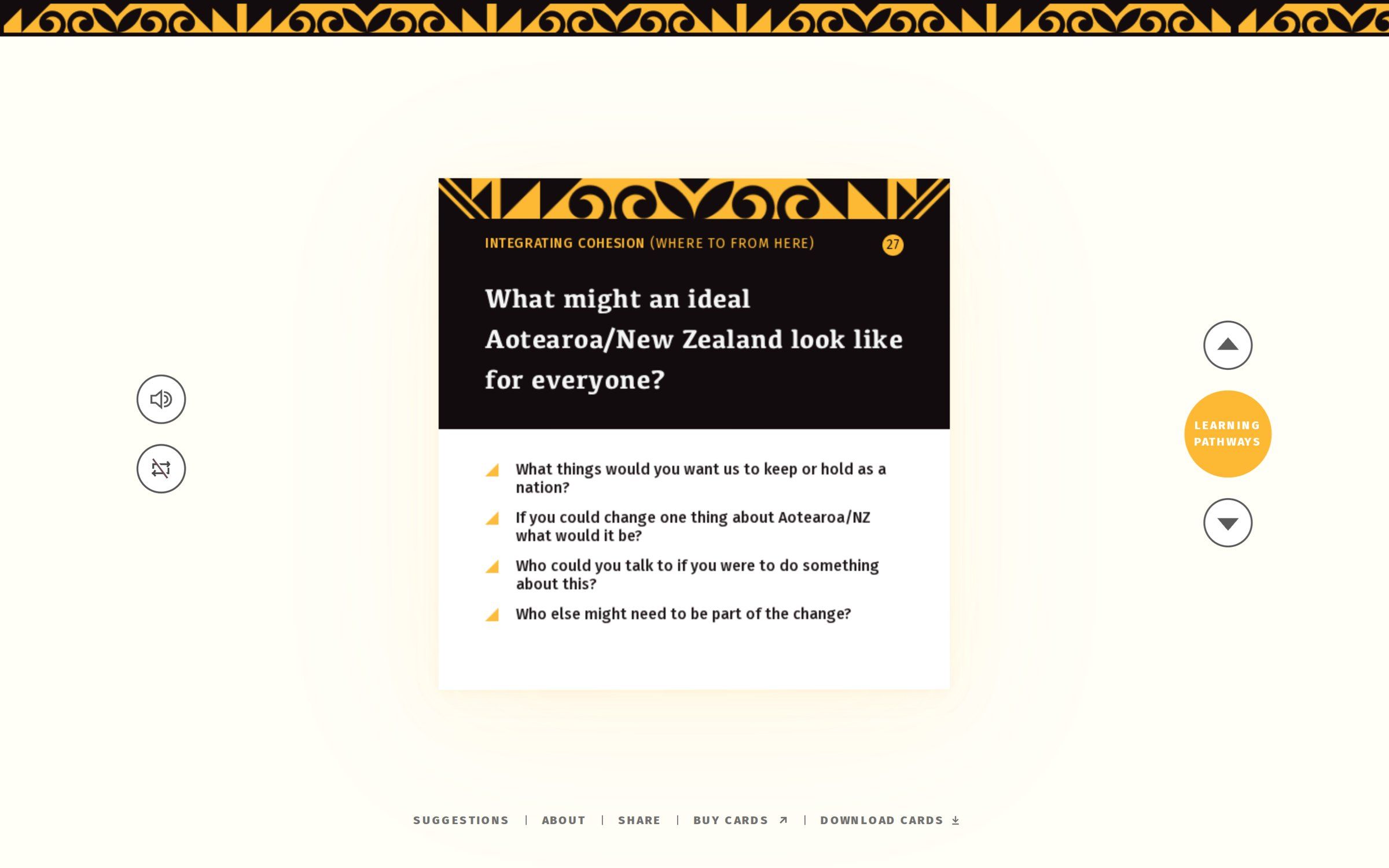
The deck, part way through the Integrating Cohesion stage. The background takes the colour of the stage you're in.
The gap we left
Budgets on projects like this are tight, and ours ran out before we got to the pathways. So for two years the eleven guides sat behind a Download PDF button. If you knew MOSAIC existed and knew which pathway you wanted, that was fine. If you were a teacher in Wairoa googling "how do I talk to my Year 8s about racism" at ten at night, the site was invisible. Google had indexed one page: the homepage. The homepage is a card deck, and to a crawler a card deck is a picture with almost no words on it.
That bothered me. The whole point of the project is that the conversations happen. A resource nobody can find doesn't help anyone. And in 2026 that goes double, because the person searching is as likely to be asking an AI assistant as typing into Google, and an assistant can only recommend a page it can read.
There was a second problem, found when we opened the code up again. The site had quietly become unbuildable. The tooling underneath it had moved on, the build had been failing for about a year, and because nothing was being changed nobody noticed. The live site kept serving the last good build from 2024. It looked fine from outside. Underneath, we couldn't have shipped a typo fix.
What we did
In late August I took a couple of days and did the work we'd always meant to do. We didn't ask Ara Taiohi for a budget. MOSAIC is a non-profit project. It exists because of a grant from the Preventing and Countering Violent Extremism fund and the Clare Foundation, and it's carried by organisations whose work is doing good on tight money. And I grew up in Christchurch. The attacks this project came out of happened in my home town. It's a project I believe in, so a couple of days of our time was an easy call.
The build got fixed first, because nothing else was possible until it was. Then every one of the eleven pathways became a full page on the site. Not a summary or a landing page with a download link. The whole guide, in the order a facilitator reads it:
- The welcome, and how to set up
- Making the space safe
- The cards for that topic, shown as the cards
- The resources
- The conversation itself, in its stages, with the facilitator notes alongside
- More learning
- The support organisations, at the end where they belong
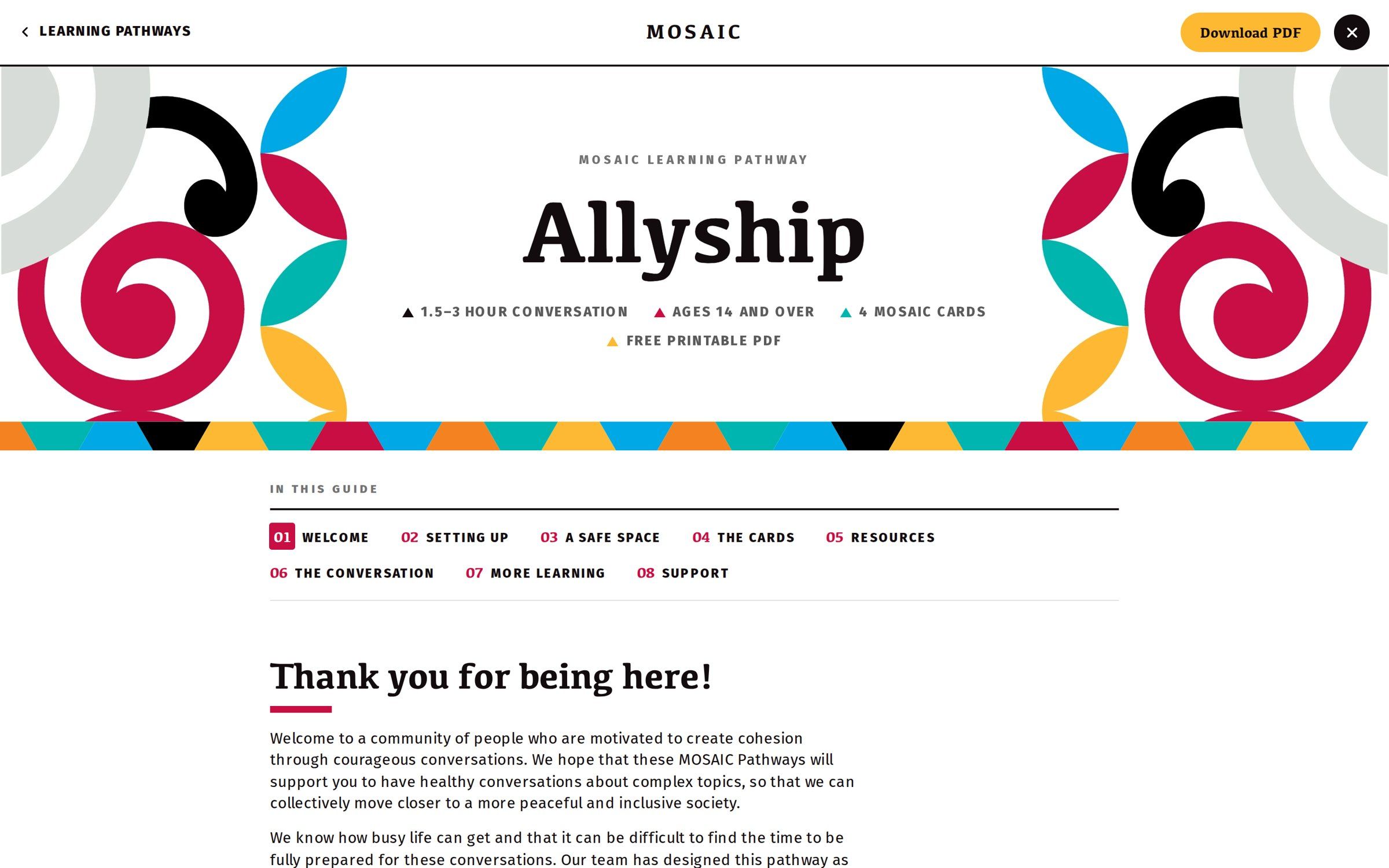
The Allyship pathway. The artwork is the guide's own cover art, mirrored, with an accent colour picked for it.
The pages are designed to feel like the printed guide coming to life rather than a second app. Each one takes the koru artwork from its own PDF cover, mirrored either side of the title, with an accent colour picked to suit it. The contents rule shows you where you are. The cards appear as the actual cards, the same components the deck uses. The conversation stages are colour-coded with the facilitator's notes alongside. The support section sits on the tessellation, so it reads as the close of the guide rather than a footer.
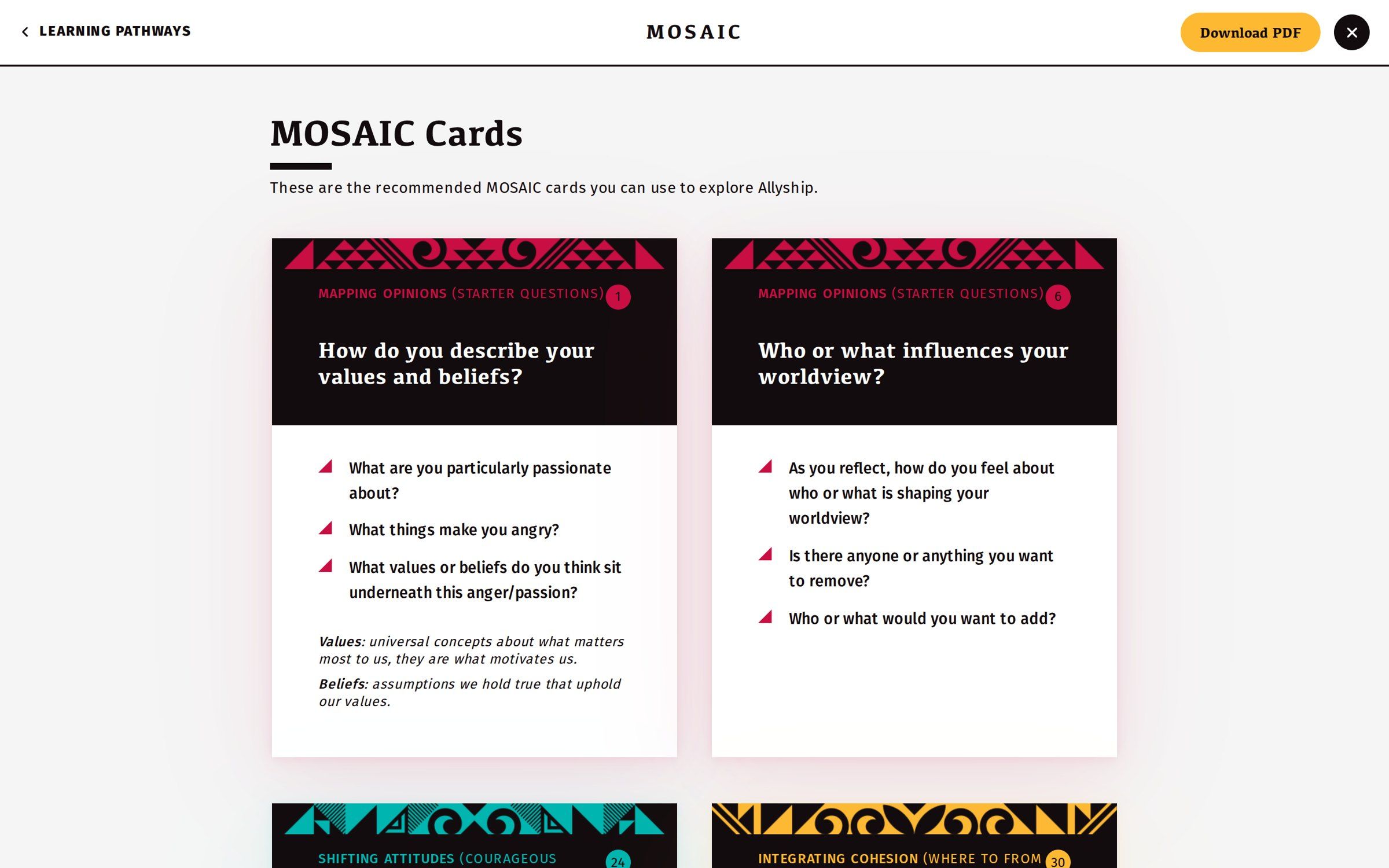
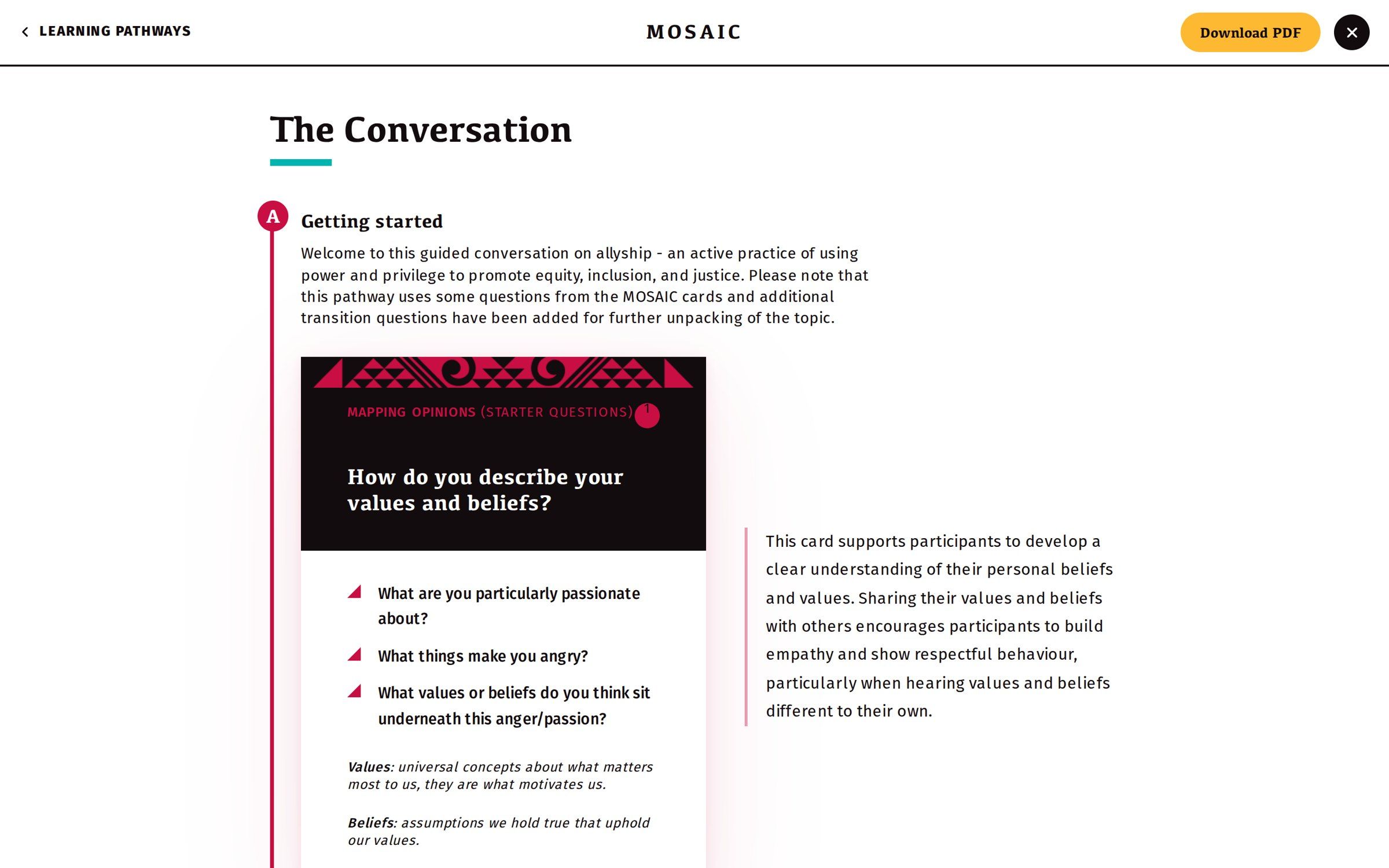
Left: the recommended cards, rendered as the real cards. Right: a conversation stage with the facilitator's notes beside it.
All of it works on a phone, which matters more than desktop here. A youth worker is more likely to have the guide open on their phone in the room than printed out.
The same journey on a phone: the deck, Learning Pathways, then scrolling the Allyship guide.
Where AI came in, and where it didn't
I'll be honest about the mechanics, because this is the part people ask about.
Two years ago, transcribing eleven PDF guides into structured, accessible web pages was weeks of careful work. That's why it didn't happen. This time, with Claude doing the transcription and the structuring, the first pathway took a day and the other ten took about two. The speed is real.
But the words on these pages aren't ours, and they aren't the AI's. They belong to the people who wrote the guides, and a facilitator standing in front of a room needs the page to say exactly what the printed guide in their hand says. So the rule was: transcribe, don't improve. Typos and all. Where a guide says "Know Better Do Bettter" with three Ts, the page says it too, and the typo went on a list for Ara Taiohi rather than getting quietly fixed by a machine.
Transcribe, don't improve. Typos and all.
To make that rule enforceable rather than hopeful, we wrote checks that run every time the site builds. One asks whether every sentence in the guide made it onto the page. Another asks the reverse: whether every sentence on the page came from that guide and not from a different one. That second check exists because on the first pass some boilerplate from the Allyship guide had been copied onto four other pathways. Reading by eye, I'd have missed it. The check didn't.
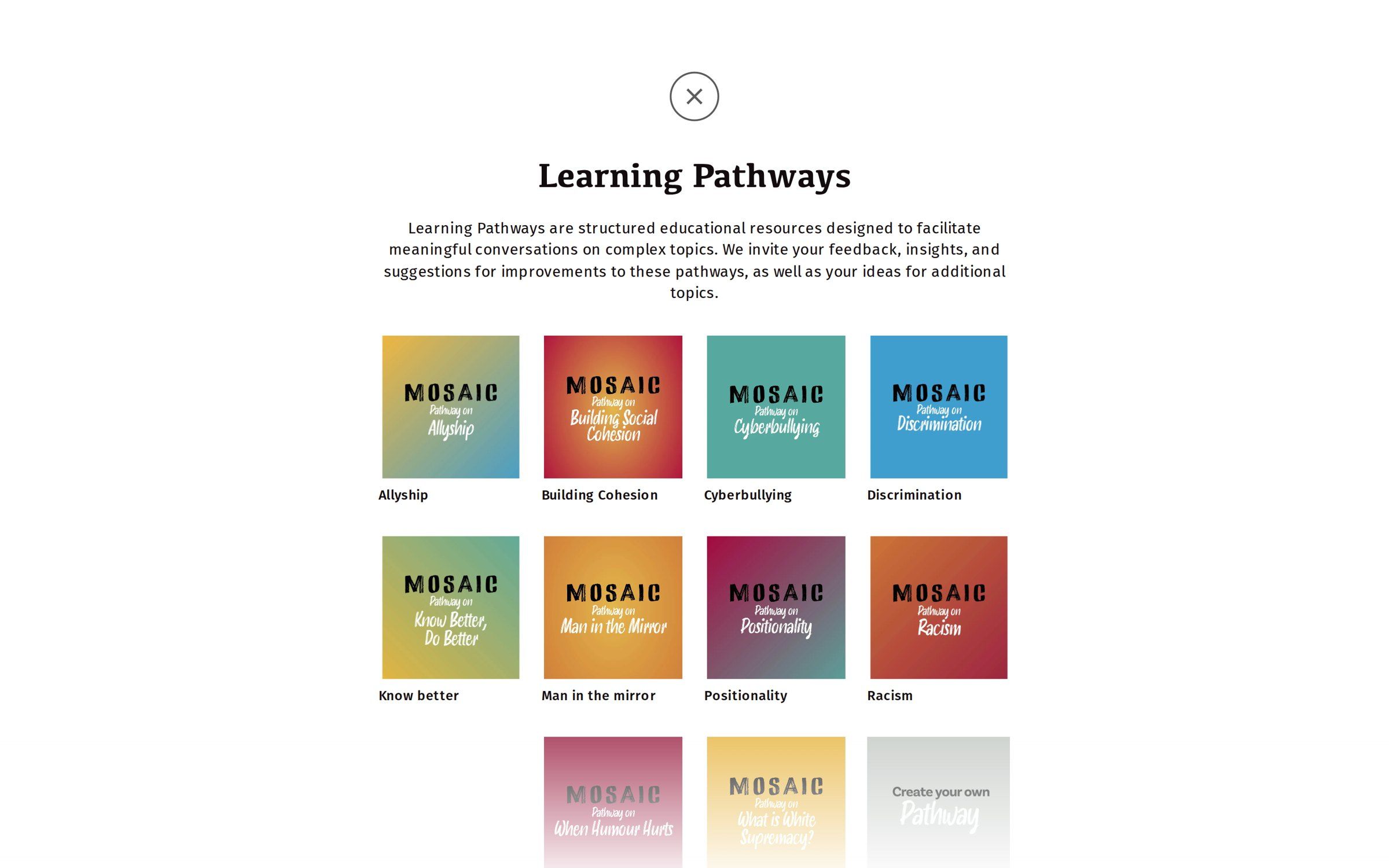
All eleven pathways, each now a page as well as a PDF.
We also checked every external link in all eleven guides. Ninety-three of them. A handful had died since the guides were written, including two in the support sections, which is the worst possible place for a dead link. One had been quietly taken over: a domain that used to host an essay on constitutional transformation now redirects to a law firm's blog in Michigan. We found the essay at its original home and pointed the page there. The rest of the issues, the ones only the authors can fix, went to Ara Taiohi as a written list.
That's the honest shape of AI in this project. It did the heavy, repetitive work in hours instead of weeks, and it did it well. The judgement about what should and shouldn't change, and the checks that hold it to that, were ours. Curated, not slop.
Small things that were sitting there
A teacher from Wairoa College had left a comment in May about using two of the cards with her Year 7 and 8 students. It had sat unmoderated for three months because nobody was looking. It's published now, first name only.
The King's Trust had changed its name from The Prince's Trust and sent us a new logo in August. That's on the site.
Google now has a sitemap with every pathway on it. Each pathway page carries structured data that describes it as a learning resource, so search engines and AI assistants know what it is rather than guessing.
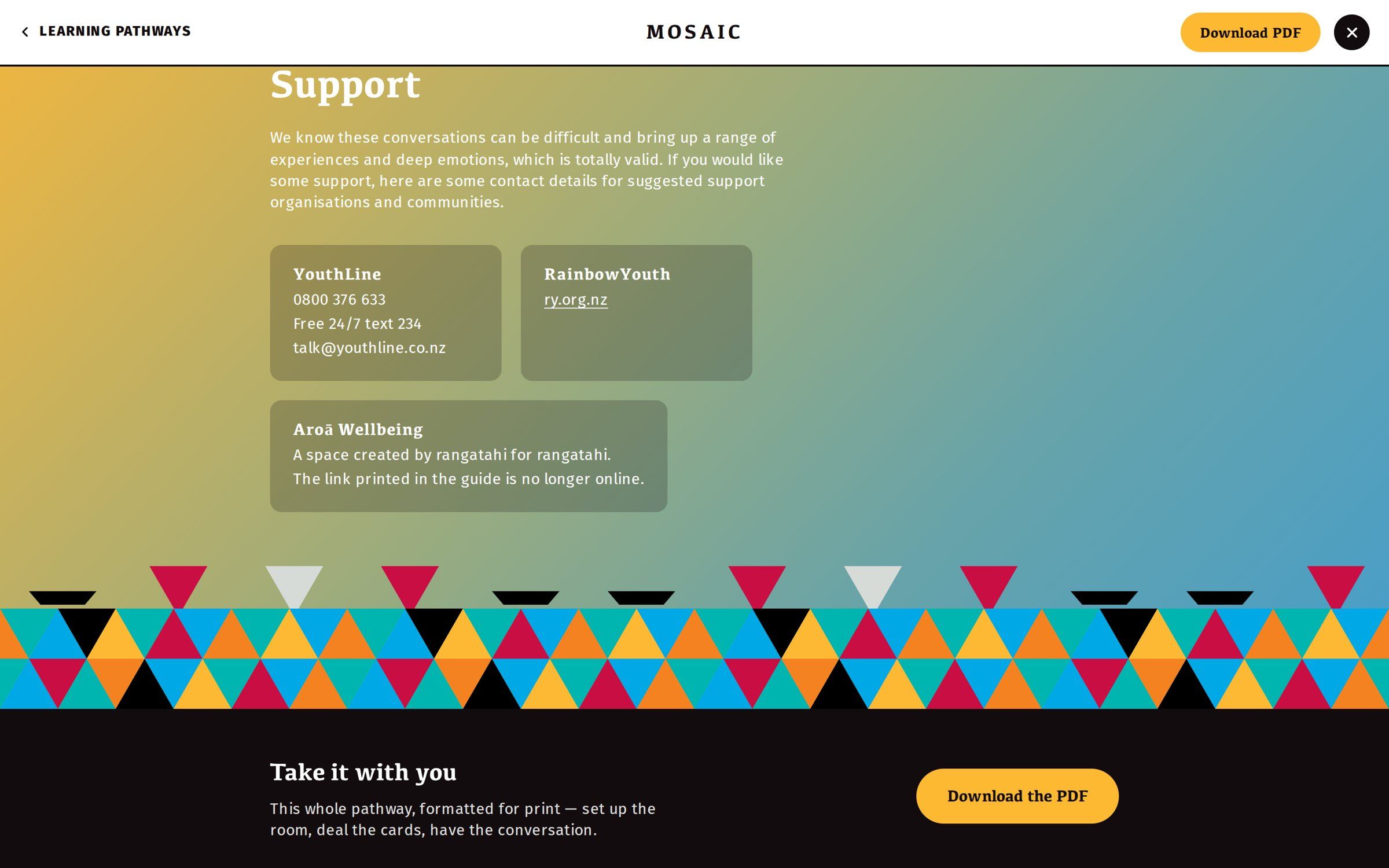
The close of every guide: who to call, then the PDF for the room.
The wider point
MOSAIC is a small project, but the problem it had is everywhere. Most organisations have their best thinking locked in PDFs: guides, reports, toolkits, the things people actually worked hard on. A PDF behind a download button ranks badly, is hard for the AI assistants people now ask first to read and cite, and is no good on a phone in a hurry. For years the honest advice was that freeing that content into real pages cost more than it was worth.
That's no longer true. The transcription is now cheap. What still costs something, and should, is the judgement: deciding what must stay word-for-word, checking every link, keeping the author's voice, knowing when a machine should stay out of it. If you run an organisation with knowledge stuck in PDFs, that's the part to spend on.
What happens next
The pages exist. Whether anyone finds them depends on things we don't control. The single biggest one is links: if Ara Taiohi, The King's Trust and the networks that endorse MOSAIC link to the pathway pages themselves rather than the homepage, search engines will treat them as pages that matter. We've asked.
The guides themselves have a short list of things worth fixing at the next print run, and that's a conversation for their authors, not us.
Far out, this is absolutely beautiful. Thank you! I shall share with our global team.
If you work with young people and you've never seen MOSAIC, the cards are at mosaicaotearoa.nz and every pathway is free to read. Pick one. Have the conversation.
MOSAIC website credits: interface design Cody Westerman, motion graphics Linus Nelson, development and sound Josh Waay, creative direction Andrew Hillstead. The card set itself was designed by Helen for Ara Taiohi.